
How AI Completely Transforms Children’s Lives in 2026
The year 2026 marks a revolutionary shift in childhood. Artificial Intelligence has moved beyond gadgets.
It now shapes how children learn, play, and grow. This transformation touches every aspect of their lives.
From personalized education to health monitoring, AI is the new normal. Let’s explore this fascinating future.
📈 Quick Insight
By 2026, 78% of children in developed nations interact with AI daily. These systems adapt to each child’s unique needs.
The result? More personalized development than ever before possible.
The AI-Powered Classroom Revolution
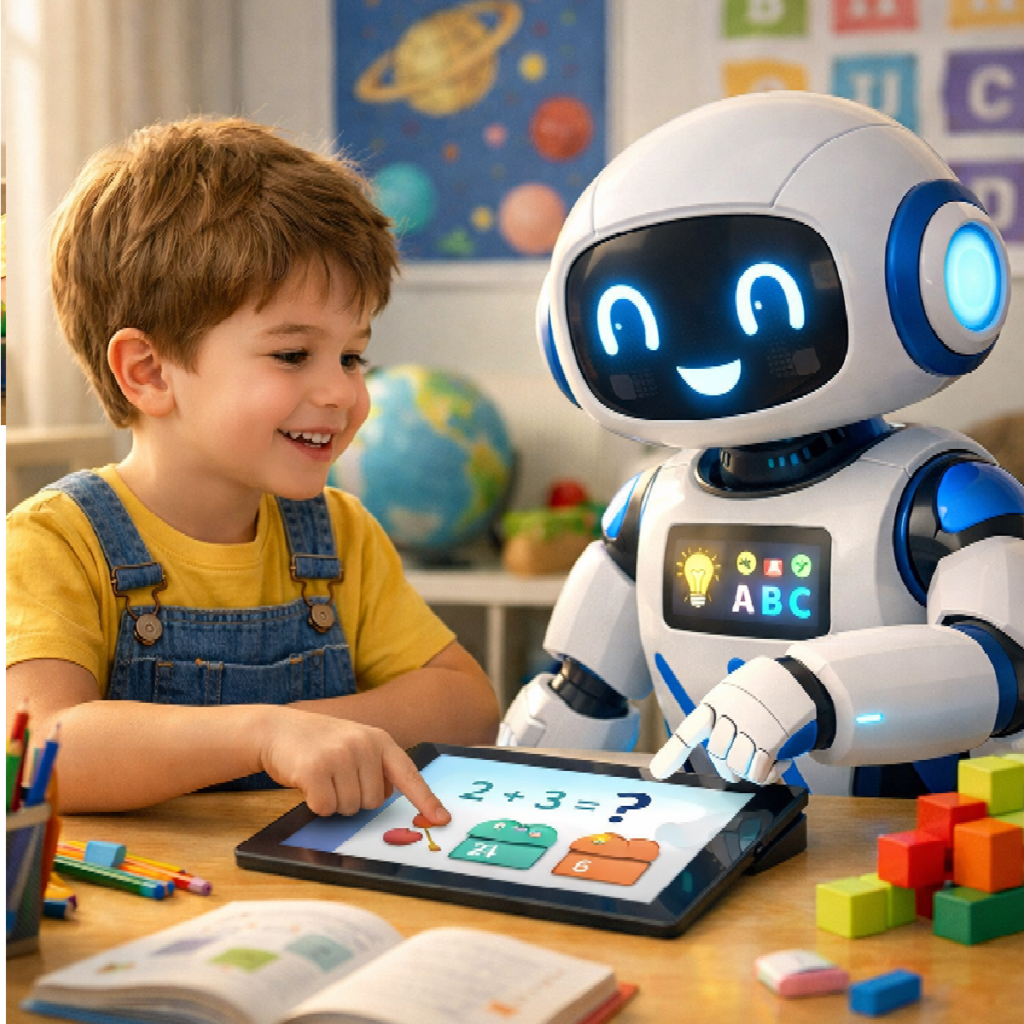
Traditional classrooms are evolving rapidly in 2026. AI tutors provide individual attention to every student.
These systems detect learning gaps instantly. They adjust teaching methods in real-time.
No child gets left behind or bored anymore.
Adaptive Learning Platforms
AI platforms like EduSmart 2026 analyze each student’s learning patterns. They create custom lesson plans.
If a child struggles with fractions, the AI provides extra practice. It uses games and interactive content.
Learning becomes engaging and effective simultaneously.
Teachers now have AI assistants. These handle grading and administrative tasks.
Educators focus on mentoring and emotional support. The human touch becomes more valuable.
Classrooms transform into collaborative learning spaces.
Personalized Health & Development Monitoring
AI wearables for children have become sophisticated by 2026. They monitor physical and mental health.
These devices track sleep patterns, nutrition, and activity levels. Parents receive actionable insights.
Early detection of health issues is now the standard.
Emotional AI helps children understand their feelings. Apps like MoodFriend teach emotional intelligence.
Children learn to identify and manage emotions early. This builds resilience and social skills.
Mental health support begins before problems escalate.
10 Powerful Expert Tips for AI-Enhanced Parenting
AI interaction should complement real-world experiences. Set clear boundaries for both.
Choose AI tools with transparent data policies. Teach children about digital privacy early.
Use AI learning tools together with your child. Discuss what you’re learning and discovering.
Teach children to question AI suggestions. Help them understand it’s a tool, not an authority.
Use different types of AI tools. Balance educational, creative, and recreational applications.
Notice how your child responds to AI interactions. Adjust based on their comfort and engagement.
Ensure AI doesn’t replace human interaction. Family time and peer play remain essential.
AI technology evolves rapidly. Regularly review and update the tools your child uses.
Help children understand how AI works in simple terms. Demystify the technology.
You know your child best. Use AI as a supplement to, not replacement for, parental judgment.
AI in Creative Development & Play
Play has transformed dramatically by 2026. AI-powered toys adapt to a child’s interests.
These toys grow with the child. They become more complex as skills develop.
Creative AI tools help children compose music or create art.
Virtual playmates powered by AI provide social practice. They help shy children develop conversation skills.
These AI companions teach empathy and cooperation. They’re available anytime for practice.
Real-world social skills improve as a result.
Safety & Ethical Considerations
With great technology comes great responsibility. 2026 brings new challenges for parents.
Data privacy remains a top concern. Children’s information requires special protection.
Thankfully, regulations have caught up with technology.
The Children’s AI Protection Act of 2025 sets strict standards. Companies must be transparent about data use.
Parents have complete control over their child’s data. Opt-out options are clear and simple.
Ethical AI development prioritizes child welfare.
Digital Citizenship Education
Schools now teach digital citizenship from kindergarten. Children learn about AI ethics early.
They understand how algorithms work. They learn to recognize AI biases.
This creates informed, critical users of technology.
Frequently Asked Questions About AI & Children
When used appropriately, AI can enhance child development. Research shows benefits in personalized learning and skill building.
The key is balance and supervision. AI should complement, not replace, human interaction and traditional play.
Choose age-appropriate, certified AI tools designed specifically for children.
Experts recommend differentiated limits based on activity type. Educational AI interaction differs from passive consumption.
For children 6+, 1-2 hours of educational AI interaction daily is reasonable. Always include regular breaks for physical activity.
Remember that interactive AI learning is more engaging than passive screen time.
No, AI enhances rather than replaces human educators. Teachers in 2026 use AI to handle administrative tasks.
This frees them to focus on mentorship, emotional support, and personalized guidance. The human connection remains irreplaceable.
AI provides data, but teachers provide wisdom, empathy, and inspiration.
Choose AI tools with strong privacy certifications. Look for compliance with the Children’s AI Protection Act.
Use parental controls to limit data sharing. Regularly review privacy settings together with your child.
Teach children about digital footprints from an early age.
Top-rated tools include EduSmart for adaptive learning, CreatiKids for creative development, and MindGuard for emotional intelligence.
Look for tools with educational endorsements and positive parent reviews. Many school districts now recommend specific AI learning platforms.
Always try free versions before committing to subscriptions.
The Future Beyond 2026
AI integration in childhood will continue evolving. The technology will become more seamless.
Future developments may include brain-computer interfaces for learning. These remain speculative but possible.
The ethical framework will continue developing alongside the technology.
Parents, educators, and developers must collaborate. They shape how AI influences future generations.
With careful guidance, AI can help children reach their full potential. It prepares them for a rapidly changing world.
The goal remains raising happy, healthy, well-adjusted humans.
Summary: Embracing the AI-Enhanced Childhood
2026 represents a pivotal moment in childhood development. AI has become an integral part of growing up.
When used responsibly, it offers unprecedented benefits. Personalized education, health monitoring, and creative development improve.
The key is balance, supervision, and ethical implementation.
Parents should stay informed and engaged. They should choose AI tools carefully and set appropriate boundaries.
Children need both technological literacy and traditional childhood experiences. AI should enhance, not replace, human connection.
The future looks bright for AI-enhanced childhood development.
📢 Share This Article
Found this information helpful? Share it with other parents and educators!
Together, we can navigate the AI revolution in childhood development.
Ready to Explore AI Tools for Your Child?
Start with research and small steps. Choose one area where AI could benefit your child.
Look for certified, age-appropriate tools with good reviews. Engage with the technology together.
Remember, you’re the most important guide in your child’s technological journey.
Explore AI Tools:- https://aitoolshere.com