
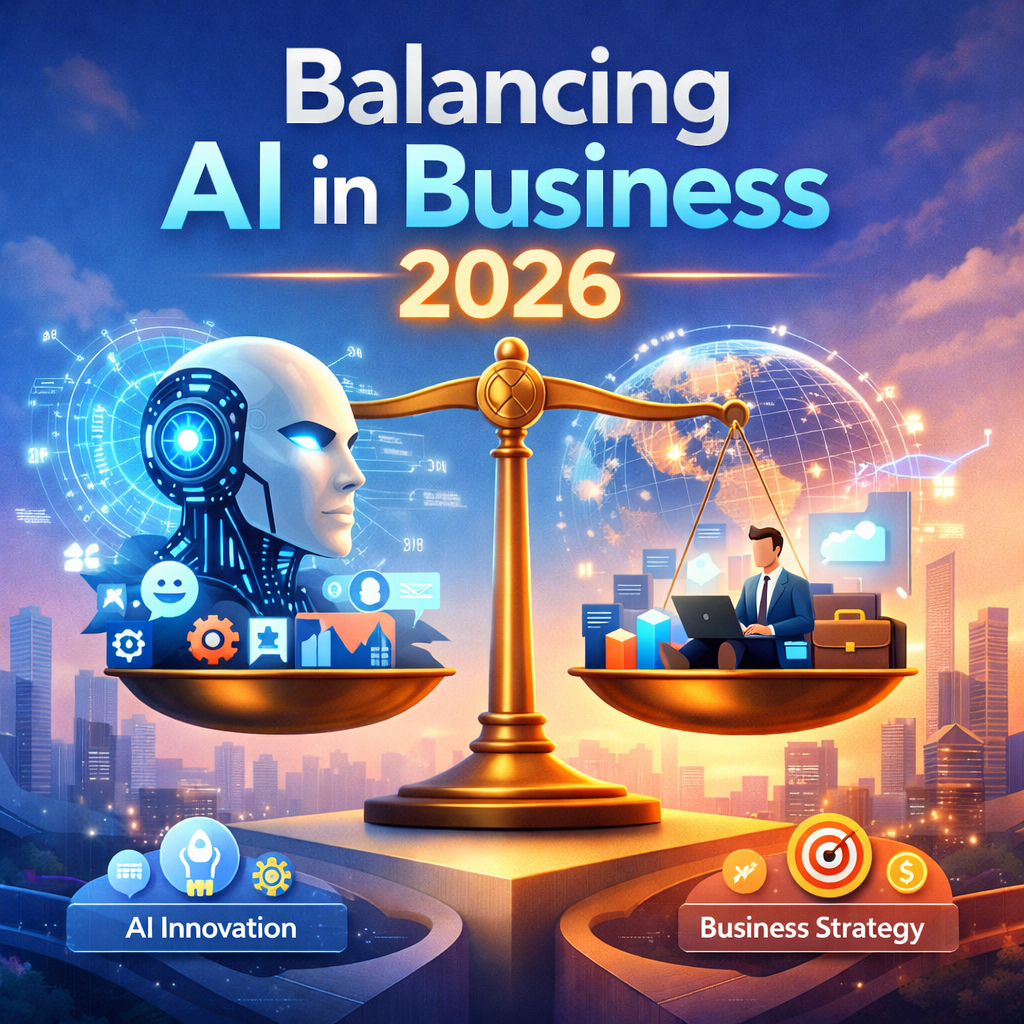
Balancing AI in Business 2026: The Strategic Playbook
Artificial intelligence is transforming every industry in 2026. But more AI isn’t always better.
The real competitive advantage comes from strategic balance. This means blending AI power with human insight.
This guide provides your strategic framework for balanced AI adoption that drives sustainable growth.
⚖️ The 2026 Balancing Act
Successful companies aren’t replacing humans with AI. They’re creating AI-augmented teams.
The most valuable skills are now AI management and strategic oversight.
Balance means maximizing ROI while maintaining ethical standards and human oversight.
Why Balance Matters More Than Ever
Early AI adoption was about automation. The 2026 phase is about intelligent augmentation.
Unchecked AI implementation creates risks: ethical dilemmas, data dependency, and skill erosion.
Strategic balance mitigates these risks while amplifying AI’s transformative potential.
The Risk of Imbalance
Over-Automation: Losing human judgment in critical decision-making processes.
Ethical Blind Spots: AI systems perpetuating bias without human oversight mechanisms.
Skill Atrophy: Employees losing essential skills by over-relying on AI assistance.
Integration Chaos: Multiple AI systems working in isolation without strategic alignment.
Companies that master balance see 3-5x higher ROI from AI investments.
They experience fewer implementation failures and maintain stronger customer trust.
Their employees are more engaged and productive with AI as a partner.
The 4 Pillars of Balanced AI Strategy
Our research identifies four essential pillars for 2026 success. These form your strategic foundation.
Each pillar requires equal attention and investment. Neglecting one undermines the entire structure.
1. Strategic Alignment
AI initiatives must directly support business goals. Every project needs clear ROI metrics.
Alignment ensures resources are focused on what truly matters for competitive advantage.
2. Human-AI Collaboration
Design workflows that leverage both human creativity and AI computational power.
Focus on augmentation, not replacement. Invest in training for new collaborative skills.
3. Ethical Governance
Establish clear ethical guidelines before implementation. Create oversight committees.
Build transparency into AI decision processes. Regular audits for bias and fairness.
4. Adaptive Infrastructure
Build flexible systems that can evolve with changing AI capabilities and business needs.
Ensure data quality and accessibility. Plan for continuous learning and improvement.
10 Expert Tips for Achieving AI Balance
Identify your biggest challenges first. Then explore if and how AI can address them specifically.
Form a cross-functional team to review AI initiatives for ethical implications before launch.
Start AI systems with human oversight. Gradually increase autonomy as trust and performance are proven.
Track both efficiency gains AND human factors like employee satisfaction and customer trust.
Help all employees understand AI capabilities and limitations. Demystify the technology.
Choose AI solutions that can explain their decisions. Avoid “black box” systems for critical functions.
Define exactly when AI systems should escalate to human judgment. Document these scenarios.
Schedule quarterly reviews of AI decisions for demographic or other unintended biases.
Include operations, HR, legal, and frontline staff in AI planning, not just IT and data scientists.
AI balance isn’t a one-time achievement. Establish quarterly review processes for adjustment.
Practical Implementation Framework
Theoretical balance is useless without practical implementation. Follow this phased approach.
Each phase builds on the previous one. Don’t skip steps even if you feel pressure to move faster.
Phase 1: Assessment & Alignment (Months 1-3)
- Conduct AI maturity assessment across all business units
- Identify 2-3 high-impact pilot areas with clear success metrics
- Establish ethical guidelines and governance structure
- Create cross-functional implementation team with executive sponsorship
Phase 2: Pilot & Learn (Months 4-9)
- Launch controlled pilots in selected areas with heavy monitoring
- Implement feedback loops from both employees and customers
- Begin AI literacy training for affected teams and leadership
- Adjust balance points based on pilot performance and feedback
Phase 3: Scale & Optimize (Months 10-18)
- Expand successful implementations to additional business areas
- Establish Center of Excellence for ongoing AI governance
- Integrate AI balance metrics into regular business reviews
- Develop advanced human-AI collaboration models based on learnings
Measuring Balance: Key Metrics for 2026
You can’t manage what you don’t measure. Traditional ROI metrics alone are insufficient.
Add these balance-specific metrics to your executive dashboard and regular reviews.
Balance Scorecard Metrics
Human Engagement Index: Employee satisfaction with AI tools and collaboration
AI Decision Transparency Score: Percentage of AI decisions with explainable reasoning
Ethical Compliance Rate: Audit results against established ethical guidelines
Skill Development Metrics: Employee progression in AI management capabilities
Customer Trust Indicators: Changes in customer satisfaction and loyalty metrics
Review these metrics quarterly with your AI Ethics Board and executive leadership.
Be prepared to adjust your balance points as you learn and as technology evolves.
Remember: The goal is optimal balance, which may shift over time.
Frequently Asked Questions
Leading companies allocate 20-30% of their total AI budget specifically for balance initiatives.
This includes ethics training, governance structures, human-AI interface design, and ongoing monitoring systems.
Consider this not as an added cost but as risk mitigation and value optimization for your core AI investment.
The single biggest mistake is focusing only on technical implementation while ignoring human and ethical dimensions.
Companies often invest millions in AI technology but only thousands in change management and ethics governance.
This imbalance leads to low adoption, employee resistance, ethical issues, and ultimately, failed ROI.
Transparency and inclusion are your most powerful tools. Involve employees early in the AI planning process.
Clearly communicate that the strategy focuses on augmentation, not replacement. Show specific examples of how AI will assist rather than replace.
Invest in reskilling programs that prepare employees for higher-value work in collaboration with AI systems.
For most businesses, a hybrid approach works best in 2026. Use established platforms for common functions.
Consider custom development only for proprietary processes that provide unique competitive advantage.
Prioritize solutions that offer explainability and integration capabilities regardless of build vs. buy decisions.
Executive Summary: Your 2026 AI Balance Checklist
Balancing AI isn’t about limiting technology. It’s about maximizing value while minimizing risk.
The companies that will lead in 2026 have already moved beyond asking “Can we implement AI?” to asking “How should we implement AI?”
Your strategic advantage comes from the wisdom of your balance, not just the power of your technology.
Quick-Start Checklist
- ✅ Form cross-functional AI governance committee
- ✅ Establish ethical guidelines before any implementation
- ✅ Identify 2-3 pilot areas with clear success metrics
- ✅ Budget 20-30% of AI funds specifically for balance initiatives
- ✅ Launch AI literacy program for all affected employees
- ✅ Create balance metrics dashboard for regular review
🚀 Ready to Lead in 2026?
Share this strategic guide with your leadership team and board members.
Begin your balanced AI transformation with our complete implementation toolkit.
Start Your AI Journey
Find modern PDF tools, SEO Tools, Maarketing Tools, Calculators and other Miscellaneous.
Free Use of AI tools, Enchance Business Producitvity, and Generate Best resultds quickly.
Explore AI Tools:- https://aitoolshere.comUsed by companies to implement balanced AI strategies