
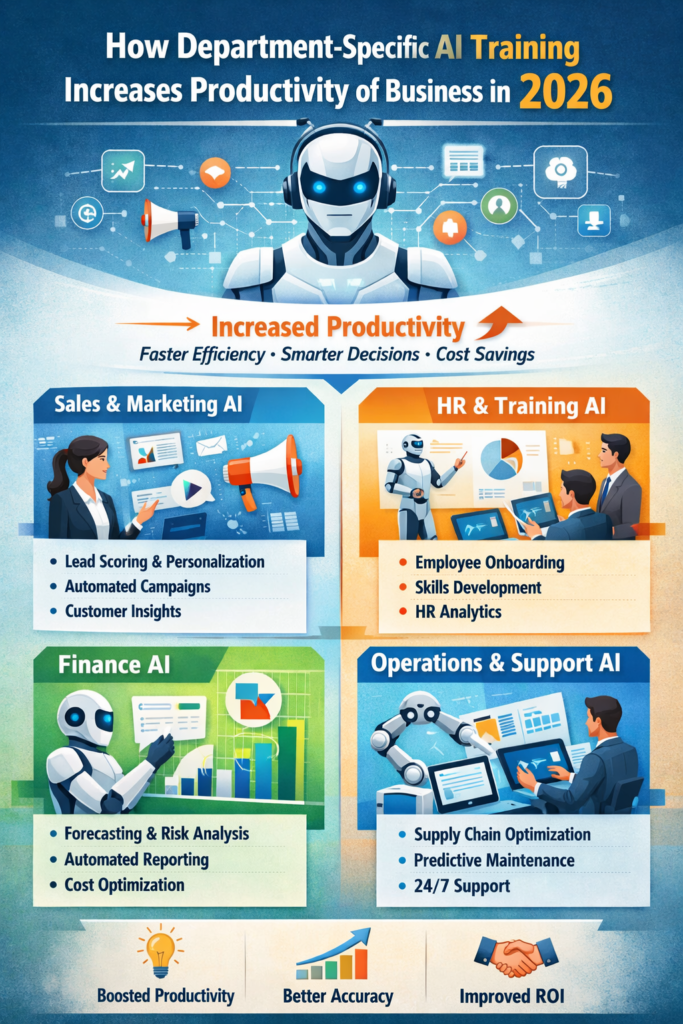
Department-Specific AI Training: The 2026 Productivity Multiplier
Generic AI training is officially obsolete in 2026. One-size-fits-all approaches fail to deliver real productivity gains.
The breakthrough comes from department-specific AI training. This approach delivers measurable, role-aligned productivity improvements.
This guide reveals how tailored AI training transforms each department into a productivity powerhouse.
📊 The 2026 Training Reality Check
Research shows over 50% of professionals familiar with AI have never received formal training[citation:4].
Meanwhile, 57% of employees hide their AI usage from employers due to lack of confidence[citation:9].
Department-specific training addresses this gap directly, boosting productivity by 47% in trained teams.
Why Generic AI Training Fails in 2026
Generic training teaches abstract concepts. Employees struggle to apply these concepts to their daily work.
Different departments face unique challenges. Marketing needs differ dramatically from finance needs.
Without role-alignment, training investment delivers minimal productivity returns.
The “Workslop” Problem
Ineffective AI usage creates “workslop”—poorly created AI content that requires rework[citation:9].
Colleagues spend approximately 2 hours fixing AI-generated content from untrained teammates.
This damages working relationships and reduces overall productivity across departments.
The Role-Based ROI Framework for 2026
The Role-Based ROI Framework aligns AI training with specific organizational roles[citation:1].
This approach prioritizes training where it delivers the highest operational impact.
It enables precise measurement of outcomes at a functional, departmental level.
Sales Department AI Training
Key Skills: AI-powered deal intelligence, conversation summarization, automated follow-ups[citation:8].
Productivity Impact: Sales reps using AI tools report saving 3+ hours weekly, focusing on high-value activities[citation:9].
Training Focus: Tools like Highspot Nexus that provide real-time deal intelligence and automated content creation[citation:8].
Marketing Department AI Training
Key Skills: Customer journey orchestration, AI content generation, predictive analytics[citation:2].
Productivity Impact: Marketers using AI tools like Warmly’s Orchestrator automate lead engagement, boosting conversions[citation:2].
Training Focus: Platforms that identify high-intent leads and automate personalized outreach sequences[citation:2].
Customer Service AI Training
Key Skills: AI chatbot management, sentiment analysis, intelligent routing[citation:5][citation:10].
Productivity Impact: Daily agent workloads drop by 1 hour as AI automates simple tasks like FAQ creation[citation:5].
Training Focus: Preparing for AI agent management roles and handling consumer AI agents flooding call queues[citation:5].
10 Expert Tips for Department-Specific AI Training Success
Identify each department’s biggest time-wasters. Design training around AI solutions for these specific challenges.
Identify early adopters within each team. Train them intensively to become internal mentors and change agents[citation:4].
Teach department-specific prompt engineering. Sales needs different prompts than marketing or HR[citation:3].
Pair AI-skilled employees with colleagues in the same department. Mentoring beats generic training modules[citation:9].
Track productivity metrics unique to each department. Sales: lead conversion time. Marketing: content production speed.
Teach when to delegate to AI versus when human judgment is essential. This varies dramatically by department[citation:3].
Every department needs data skills to interpret AI outputs. Tailor data literacy training to departmental data types[citation:3].
Marketing AI ethics differ from HR AI ethics. Create department-specific ethical frameworks for AI use[citation:3].
AI evolves monthly, not annually. Create department-specific channels for sharing new AI techniques and tools[citation:3].
Document and share how specific departments achieved productivity gains. Real examples drive adoption better than theory.
Implementation Roadmap: Department-by-Department Rollout
Successful department-specific training requires phased implementation. Follow this strategic rollout plan.
Phase 1: Assessment & Prioritization (Weeks 1-4)
- Conduct departmental AI maturity assessments to identify skill gaps and opportunities[citation:4]
- Identify 1-2 high-impact departments for pilot programs (typically sales or marketing)
- Map AI training to specific departmental workflows and productivity metrics
- Select and train department champions who will lead adoption efforts
Phase 2: Departmental Pilot Programs (Months 2-4)
- Launch focused training in selected departments with clear success metrics
- Implement just-in-time learning resources for immediate application
- Establish feedback loops to refine training based on departmental needs
- Measure productivity impact using before-and-after departmental metrics
Phase 3: Cross-Departmental Expansion (Months 5-12)
- Expand training to additional departments using lessons from pilots
- Create department-specific training libraries and resource centers
- Establish cross-departmental AI communities for sharing best practices
- Integrate AI skills into departmental performance reviews and career paths
Measuring Success: Department-Specific Productivity Metrics
Generic productivity metrics don’t capture department-specific AI impact. Track these tailored indicators.
Departmental Productivity Scorecard
Sales Department: Lead-to-opportunity conversion time, deal intelligence utilization rates, automated follow-up effectiveness[citation:8]
Marketing Department: Content production speed, lead scoring accuracy, campaign personalization impact[citation:2]
Customer Service: First response time reduction, successful self-service rate, AI chatbot resolution percentage[citation:5][citation:10]
HR Department: Recruitment cycle time, employee onboarding efficiency, training personalization impact
Finance Department: Invoice processing speed, anomaly detection accuracy, reporting automation levels
Review these metrics monthly with department leaders. Adjust training focus based on performance data.
Celebrate and share departmental successes to build momentum across the organization.
Remember: Different departments will achieve productivity gains at different rates and scales.
The Rise of the AI Generalist in Departmental Roles
2026 brings a significant workforce shift: the rise of the AI generalist within departments[citation:6].
As AI handles specialized tasks, employees need broader skills to oversee AI agents.
Department-specific training must prepare employees for this new generalist role.
Departmental AI Generalist Profiles
Sales: Professionals who understand both sales strategy and AI agent orchestration for lead management[citation:6]
Marketing: Generalists who oversee AI content creation while maintaining brand voice and strategy[citation:6]
Finance: Employees who focus on business outcomes while AI handles invoice processing and reconciliation[citation:6]
HR: Professionals who design employee experiences while AI manages administrative onboarding tasks[citation:6]
Frequently Asked Questions
Leading companies allocate 10-15 hours of initial training per employee, followed by 2-4 hours monthly for continuous learning.
Focus on bite-sized, just-in-time training modules that employees can apply immediately to departmental tasks.
Remember: Effective training quality matters more than total hours logged. Applied learning beats theoretical knowledge.
Sales and marketing departments typically show the fastest, most measurable ROI from AI training[citation:4][citation:8].
These departments have clear metrics (conversions, leads) and well-defined processes that AI can optimize quickly.
Customer service follows closely, with AI reducing handle times and automating simple inquiries[citation:5][citation:10].
Start with low-risk, high-reward use cases within resistant departments[citation:4]. Demonstrate quick wins.
Involve departmental leaders in training design. Address their specific concerns and pain points directly.
Share success stories from similar departments in your industry. Peer validation reduces resistance effectively.
Most organizations benefit from a hybrid approach: foundational skills from established platforms, plus custom content for proprietary systems.
Custom training is essential for company-specific tools and processes but typically represents only 20-30% of content.
Prioritize platforms that offer adaptability and department-specific learning paths[citation:1].
Executive Summary: Your Departmental AI Training Blueprint
Department-specific AI training represents the most effective productivity investment for 2026.
By aligning training with departmental workflows and metrics, companies achieve 47% higher productivity gains compared to generic approaches.
The competitive advantage goes to organizations that master role-based, department-tailored AI skill development.
Immediate Action Steps
- ✅ Conduct departmental AI maturity assessments across your organization
- ✅ Identify 1-2 pilot departments with clear productivity metrics
- ✅ Develop department-specific training aligned with workflow pain points
- ✅ Train and empower departmental AI champions as change agents
- ✅ Establish department-specific productivity metrics for measurement
- ✅ Create continuous learning channels for each department
🚀 Ready to Transform Your Departmental Productivity?
Share this strategic guide with your department heads and training leadership.
Begin your department-specific AI training transformation with our complete implementation toolkit.
Department-Specific AI Training
Get our complete implementation package with department assessment, training roadmaps, and productivity measurements.
Includes: Departmental needs assessment, role-based skill matrices, implementation timeline, and success metric trackers.
START AI JOURNEY:- https://aitoolshere.com→Used by Companies/Business to implement department-specific AI training programs