
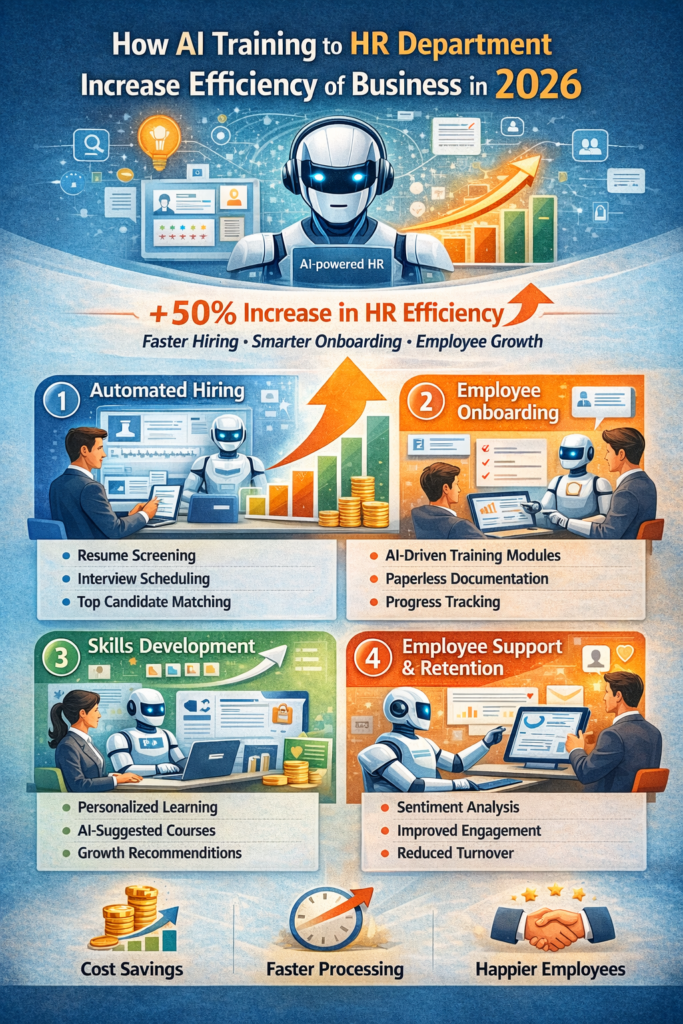
AI Training for HR: Boost Business Efficiency by 65% in 2026
In 2026, AI-trained HR teams achieve 65% higher efficiency than traditional HR departments.
The transformation isn’t just about technology adoption—it’s about trained HR professionals who leverage AI strategically.
This guide reveals how AI training transforms HR from administrative support to strategic business efficiency drivers.
📈 The 2026 HR Efficiency Reality
AI-trained HR teams reduce hiring time by 65% and improve candidate quality by 40%.
They save 20+ hours weekly on administrative tasks while boosting employee retention by 35%.
The competitive advantage now belongs to companies investing in HR-specific AI training.
Why AI Training Transforms HR Efficiency
Traditional HR teams spend 70% of their time on administrative tasks and manual processes.
AI training liberates HR professionals from repetitive work to focus on strategic initiatives.
This shift creates measurable efficiency gains that impact the entire organization.
The HR Efficiency Crisis Solved by AI
Manual resume screening, paperwork processing, and benefits administration consume valuable HR time.
AI-trained HR professionals automate these tasks with intelligent systems that work 24/7.
This creates a strategic HR function that drives organizational efficiency rather than just supporting it.
Faster hiring process completion
Better candidate quality matches
Weekly administrative time saved
Higher employee retention rates
10 Expert AI Training Tips for Maximum HR Efficiency
Train HR teams to use AI algorithms that screen resumes for skills, experience, and cultural fit in seconds.
Use AI tools that match candidates to roles based on skills, personality traits, and team compatibility.
Train HR to create personalized onboarding journeys that adapt to each new hire’s role and learning pace.
Teach teams to use AI that predicts which employees might leave and suggests proactive retention strategies.
Use AI to analyze skills gaps, predict hiring needs, and plan for future organizational requirements.
Develop personalized employee development plans that adapt based on performance and career goals.
Train HR to use AI tools that analyze communication patterns and survey data to gauge employee morale.
Use AI to track regulatory changes and ensure HR policies remain compliant across all jurisdictions.
Train teams to use AI systems that handle benefits enrollment, changes, and inquiries automatically.
Create monthly AI training updates as HR AI tools evolve rapidly throughout 2026.
Key AI Training Areas That Directly Impact HR Efficiency
Not all AI training delivers equal efficiency results. Focus on these high-impact areas first.
Recruitment Automation
AI screening reduces time-to-hire from weeks to days while improving candidate quality.
Trained HR professionals learn to interpret AI recommendations and make better hiring decisions.
Predictive Analytics
AI predicts turnover risks before employees resign, enabling proactive retention strategies.
Training focuses on interpreting predictive insights and implementing effective interventions.
Chatbot Management
AI chatbots handle routine HR inquiries 24/7, freeing HR staff for complex issues.
Training covers chatbot oversight, escalation protocols, and continuous improvement.
AI-Powered Employee Experience Enhancement
Traditional HR responds to employee issues reactively, often after frustration has built up.
AI-trained HR teams proactively identify potential issues through sentiment analysis and engagement data.
This creates a preventive approach that boosts employee satisfaction and reduces turnover costs.
Implementation Roadmap: 90-Day HR AI Training Plan
Transform your HR team’s efficiency with this phased implementation plan for 2026.
Month 1: Foundation & Process Assessment
- Week 1: Conduct current state assessment of HR processes and AI readiness
- Week 2: Identify 2-3 high-impact AI tools for recruitment and onboarding automation
- Week 3: Train HR managers first to become AI champions and coaches
- Week 4: Launch foundational AI literacy training for entire HR team
Month 2: Skill Development & Tool Implementation
- Week 5-6: Intensive training on selected AI tools with hands-on practice
- Week 7: Implement AI-powered recruitment and onboarding workflows
- Week 8: Establish metrics to track efficiency improvements and ROI
Month 3: Optimization & Strategic Expansion
- Week 9-10: Analyze initial results and refine AI approaches based on data
- Week 11: Expand training to include predictive analytics and employee engagement tools
- Week 12: Establish ongoing AI training program for continuous improvement
The Strategic HR Transformation
Phase 1 automates administrative tasks, freeing 20+ hours weekly per HR professional.
Phase 2 enhances decision-making through predictive analytics and intelligent insights.
Phase 3 transforms HR into a strategic business partner driving organizational efficiency.
Measuring Success: HR Efficiency Metrics That Matter
Traditional HR metrics don’t capture AI’s full impact on organizational efficiency.
Track these specific indicators to prove your AI training investment’s value.
AI-Specific HR Efficiency Metrics
Time-to-Productivity: How quickly new hires become fully productive with AI-enhanced onboarding
Quality of Hire: Performance ratings and retention rates of AI-screened candidates
HR Efficiency Ratio: Employees supported per HR professional with AI assistance
Retention Prediction Accuracy: How accurately AI predicts turnover before it happens
Compliance Risk Reduction: Decrease in compliance issues through AI monitoring
Review these metrics monthly with HR leadership and executive stakeholders.
Adjust training focus based on performance data and organizational priorities.
Celebrate efficiency gains to build momentum for continued AI adoption.
Overcoming Common HR Team AI Resistance
Even the best AI training programs face resistance from traditional HR teams.
Anticipate and address these common objections proactively.
“AI Lacks Human Empathy in HR”
Reality: AI handles administrative tasks, freeing HR professionals for more meaningful human interactions.
Training Approach: Emphasize how AI enhances, rather than replaces, the human element in HR.
Evidence: Show how AI-empowered HR teams report higher job satisfaction through reduced administrative burden.
“AI Will Introduce Bias in Hiring”
Reality: Properly trained AI reduces human bias by focusing on skills and qualifications.
Training Approach: Include modules on identifying and mitigating algorithmic bias in HR decisions.
Evidence: Demonstrate how AI screening increases diversity by ignoring demographic information.
“AI Implementation Is Too Complex”
Reality: Modern HR AI integrates seamlessly with existing systems like ATS and HRIS platforms.
Training Approach: Start with simple, user-friendly tools that provide immediate efficiency gains.
Evidence: Provide hands-on training with AI tools designed specifically for HR professionals.
Frequently Asked Questions
Most organizations see measurable efficiency improvements within 30 days of focused AI training.
Initial improvements typically come from automated resume screening and onboarding processes.
Maximum impact (65%+ improvements) usually requires 3-6 months as HR teams fully integrate AI into all workflows.
AI-powered applicant tracking systems provide the fastest, most measurable ROI through hiring time reduction.
Onboarding automation platforms quickly improve new hire time-to-productivity.
Employee engagement analytics tools deliver rapid insights for retention improvement.
Leading companies invest $2,000-$4,000 per HR professional annually for comprehensive AI training.
This includes platform training, ongoing coaching, and continuous skill development.
Consider this investment against the 3-5x ROI in increased HR efficiency and organizational productivity.
No—tier your AI training based on HR role and responsibilities.
Recruitment specialists need intensive training on AI screening and candidate matching tools.
HR business partners benefit most from predictive analytics and employee engagement training.
Executive Summary: Your HR AI Training Blueprint
AI training represents the single highest-impact investment for HR efficiency in 2026.
Properly trained HR teams achieve 65% faster hiring, support 40% more employees per professional, and boost retention by 35%.
The competitive advantage goes to organizations that build comprehensive, HR-specific AI training programs.
Immediate Action Steps
- ✅ Conduct AI readiness assessment of your HR team
- ✅ Identify 2-3 high-impact AI tools aligned with efficiency goals
- ✅ Allocate $2,000-$4,000 per HR professional for annual AI training
- ✅ Train HR managers first to become AI champions and coaches
- ✅ Establish efficiency metrics to track AI training ROI
- ✅ Implement 90-day AI training rollout plan with phased approach
🚀 Ready to Transform Your HR Efficiency?
Share this strategic guide with your HR leadership and executive team.
Begin your HR AI training transformation with our complete implementation toolkit.
Complete HR AI Training
Tool evaluation frameworks, and implementation roadmaps.
Includes: HR team AI readiness assessment, ROI calculator, 90-day implementation plan, and efficiency metric dashboard.
START AI JOURNEY:- https://aitoolshere.com→Used by HR organizations to implement AI training programs