
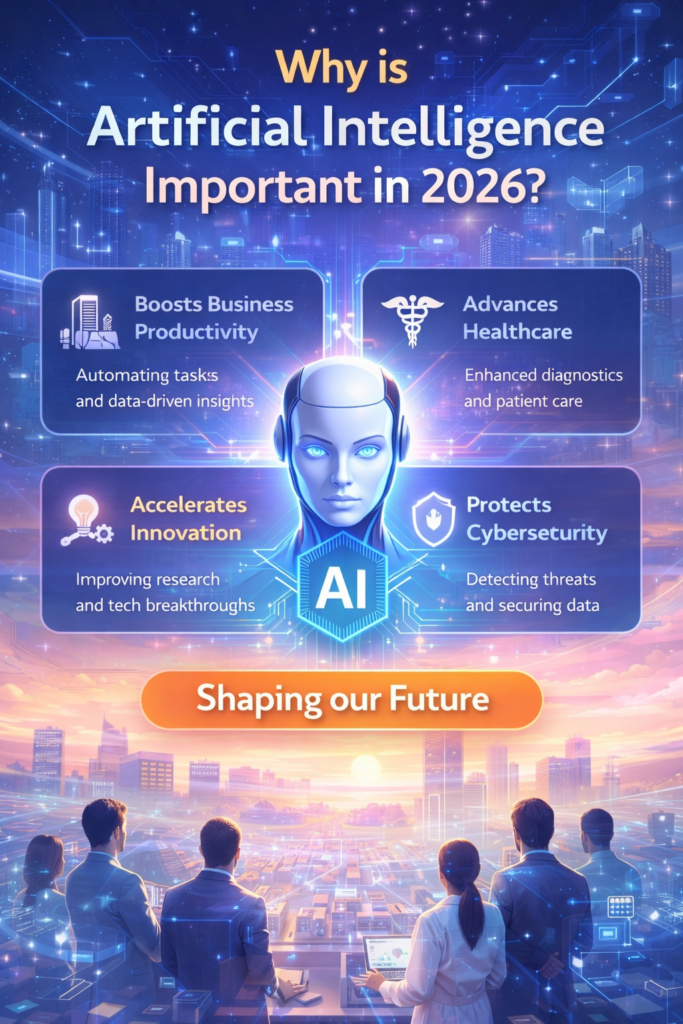
Why Artificial Intelligence is Important in 2026: The Complete Guide
Artificial Intelligence has transformed from a sci-fi concept to everyday reality. In 2026, AI is everywhere around us.
It powers our phones, healthcare, transportation, and businesses. Understanding why AI matters is now essential knowledge.
This comprehensive guide explains the importance of AI in simple terms. Let’s explore why 2026 is the AI era.
🚀 The 2026 AI Revolution
By 2026, AI contributes $15.7 trillion to the global economy according to PwC research.
It has become the most transformative technology since the internet, affecting every industry and daily life.
Companies without AI strategies are already falling behind competitors. Individuals without AI skills face career limitations.
Top 10 Reasons AI is Essential in 2026
Artificial Intelligence isn’t just another technology trend. It’s the foundation of our future society.
Here are the key reasons why AI has become indispensable in 2026 across all aspects of life and business.
AI drives unprecedented economic growth. It creates new industries while transforming existing ones.
Productivity gains from AI add trillions to global GDP annually. Countries leading in AI enjoy competitive advantages.
AI diagnoses diseases earlier and more accurately than human doctors. It personalizes treatment plans for better outcomes.
Medical research accelerates dramatically with AI analyzing complex data patterns humans can’t detect.
AI optimizes energy consumption across industries and cities. It models climate patterns to predict and mitigate disasters.
Smart agriculture systems reduce water usage while increasing crop yields. AI is essential for sustainable development.
Companies using AI outperform competitors by 30-50% in productivity. AI automates routine tasks while enhancing human creativity.
Customer experiences become personalized at scale. Supply chains optimize themselves in real-time.
AI tailors learning to each student’s pace and style. It identifies knowledge gaps before they become problems.
Educational resources become accessible globally, reducing inequality. Teachers focus more on mentorship than administration.
Smart homes anticipate needs and optimize energy use. AI assistants manage schedules, finances, and household tasks.
Transportation becomes safer with autonomous vehicles. Entertainment becomes immersive and interactive.
AI processes research data millions of times faster than humans. It identifies patterns leading to breakthrough discoveries.
Drug development timelines shrink from years to months. Space exploration advances with AI-powered analysis.
AI detects cyber threats before they cause damage. It monitors infrastructure for potential failures.
Public safety improves with predictive policing and disaster response systems. Fraud detection becomes nearly instantaneous.
AI-powered tools help people with disabilities navigate the world. Real-time translation breaks language barriers.
Voice interfaces enable technology use without traditional computer skills. Society becomes more inclusive.
AI models complex systems like pandemics, economic crises, and resource allocation. It helps policymakers make better decisions.
Global challenges require AI’s processing power and pattern recognition capabilities for effective solutions.
AI contribution to global economy by 2026
Business interactions with AI by 2026
Economic growth attributed to AI products
New AI-related jobs created by 2026
AI’s Impact on Key Industries in 2026
No industry remains untouched by artificial intelligence. The transformation varies by sector but affects everyone.
Here’s how AI reshapes major industries, creating new opportunities while solving old challenges.
Healthcare Transformation
AI analyzes medical images with superhuman accuracy. It detects cancers years earlier than traditional methods.
Personalized medicine becomes standard. Treatment plans consider genetics, lifestyle, and real-time health data.
Drug discovery accelerates from 10+ years to under 2 years for many conditions. Mental health support becomes accessible 24/7.
Business & Finance Evolution
AI handles 80% of customer service interactions with higher satisfaction than human-only systems.
Financial fraud detection happens in milliseconds. Investment strategies optimize using predictive analytics.
Supply chains self-optimize, reducing waste and improving efficiency. Hiring processes become more objective and effective.
Education Revolution
Every student receives personalized learning paths. AI tutors provide 24/7 support tailored to individual needs.
Teachers focus on higher-order thinking skills while AI handles grading and administrative tasks.
Education becomes more accessible globally, reducing inequality. Skills training adapts to market needs in real-time.
The Human-AI Partnership in 2026
Contrary to popular fear, AI isn’t replacing humans. It’s augmenting human capabilities in remarkable ways.
The most successful organizations and individuals in 2026 master the human-AI partnership model.
The Augmentation Advantage
Enhanced Creativity: Artists use AI to explore new artistic styles and generate initial concepts.
Writers use AI for research and initial drafts, focusing their energy on refinement and voice.
Amplified Decision-Making: Executives use AI to analyze millions of data points for strategic decisions.
Doctors combine AI diagnostics with human empathy and clinical judgment for optimal patient care.
Democratized Expertise: AI makes expert-level knowledge accessible to everyone.
Small businesses access market insights previously available only to large corporations with big research budgets.
Ethical AI: Why Responsible Development Matters
With great power comes great responsibility. AI’s importance includes ethical development and deployment.
In 2026, responsible AI practices determine which technologies succeed and which face public rejection.
Key Ethical Principles for 2026 AI
Transparency: AI systems must explain their decisions in understandable terms.
Fairness: Algorithms must be tested for bias and regularly audited for discriminatory patterns.
Privacy: Personal data requires strong protection with clear user control and consent mechanisms.
Accountability: Clear responsibility chains for AI decisions and their consequences.
Human Oversight: Critical decisions always involve human review and final authority.
Preparing for an AI-Driven Future
Adapting to an AI-powered world requires specific preparation. Both individuals and organizations need strategies.
Here are actionable steps to thrive in the 2026 AI landscape rather than merely surviving it.
For Individuals
- Develop AI Literacy: Understand basic AI concepts, capabilities, and limitations
- Cultivate Uniquely Human Skills: Empathy, creativity, critical thinking, and complex problem-solving
- Learn to Work with AI Tools: Master AI assistants and productivity enhancers relevant to your field
- Stay Adaptable: Embrace continuous learning as AI capabilities evolve rapidly
- Understand Data Fundamentals: Basic data literacy becomes as important as traditional literacy
For Organizations
- Develop AI Strategy: Integrate AI into core business processes rather than treating it as separate
- Invest in Employee Training: Upskill workforce for human-AI collaboration rather than replacement
- Establish Ethical Guidelines: Create clear policies for responsible AI development and use
- Build Data Infrastructure: Quality data is the fuel for effective AI systems
- Foster Innovation Culture: Encourage experimentation with AI applications across departments
Frequently Asked Questions
AI transforms jobs rather than eliminating them entirely. While some routine tasks become automated, 97 million new AI-related jobs are created by 2026 according to the World Economic Forum.
Most occupations evolve to include AI collaboration. The key is developing skills that complement AI rather than compete with it.
Jobs emphasizing human connection, creativity, and complex judgment actually grow in the AI era. Lifelong learning becomes essential for career resilience.
2026 represents a critical inflection point where AI transitions from experimental to essential infrastructure. Several factors converge:
Technology Maturity: AI systems reach reliability levels suitable for critical applications. Economic Impact: AI contributions become measurable in trillions of dollars globally.
Regulatory Frameworks: Clear guidelines emerge for responsible AI development and deployment. Societal Integration: AI becomes seamlessly integrated into daily life and business operations.
By 2026, AI becomes dramatically more accessible and affordable. Several developments enable small business adoption:
Cloud-based AI Services: Pay-as-you-go models eliminate large upfront investments. Pre-built AI Solutions: Industry-specific packages address common business needs affordably.
Government Support: Many regions offer subsidies and training programs for SME AI adoption. Open Source Tools: High-quality AI frameworks remain free with strong community support.
The ROI for even basic AI implementation typically justifies the investment within months for most businesses.
While AI offers tremendous benefits, responsible development addresses several key risks:
Algorithmic Bias: AI systems can perpetuate or amplify existing societal biases if not carefully designed and monitored.
Job Market Disruption: While new jobs emerge, transition periods can be challenging without proper retraining programs.
Privacy Concerns: Extensive data collection required for AI raises legitimate privacy questions requiring strong safeguards.
Security Vulnerabilities: AI systems themselves can become targets for sophisticated cyber attacks requiring robust protection.
2026 sees increased focus on mitigating these risks through technology improvements, regulations, and ethical guidelines.
Summary: AI’s Central Role in Our 2026 World
Artificial Intelligence has evolved from specialized tool to societal foundation. In 2026, AI importance spans every domain.
From healthcare breakthroughs to climate solutions, business transformation to daily convenience, AI enables progress at unprecedented scale.
The most successful individuals and organizations don’t just use AI—they understand its importance and integrate it thoughtfully.
Key Takeaways for 2026
- ✅ AI contributes $15.7 trillion to the global economy, driving unprecedented growth
- ✅ Healthcare transforms with earlier diagnosis, personalized treatment, and accelerated research
- ✅ Climate change solutions depend on AI’s ability to model complex systems and optimize resources
- ✅ Business productivity increases 30-50% for AI-adopting organizations
- ✅ Education becomes personalized and accessible globally through AI-powered platforms
- ✅ Ethical AI development determines which technologies succeed and earn public trust
🌍 Share This AI Importance Guide
Help others understand why artificial intelligence matters in our 2026 world.
Share this comprehensive guide with colleagues, friends, and community members.
Download Your Complete 2026 AI Readiness Toolkit
Get our comprehensive workbook with assessment tools, implementation guides, and learning resources.
Includes: AI literacy assessment, industry impact analysis, skill development roadmap, and ethical guidelines checklist.
START AI JOURNEY:- https://aitoolshere.com→Used by individuals and organizations worldwide to prepare for the AI-driven future
2025 GNServices Ltd. MultiTool – Free Online Document Tools | All rights reserved
Your privacy is our priority – files are never uploaded to any server